
Salesforce Sales Cloud
Sales Cloud your team actually wants to open
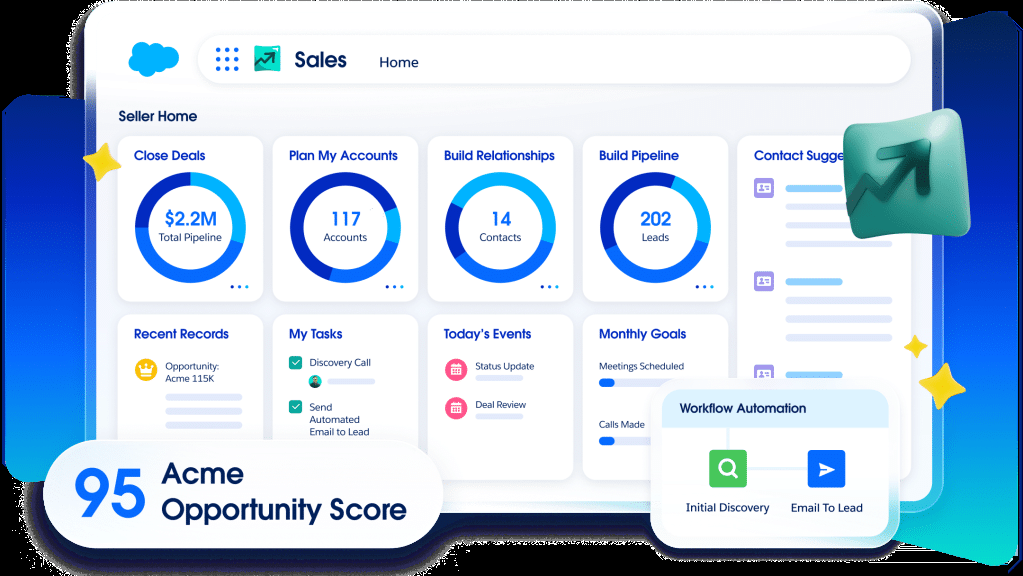
Clear pipeline, quotes that get approved on their own and agents that qualify and follow up for your reps. More time selling, less time filling in fields.
 Salesforce
 Data 360
 Agentforce
 Slack
Slack SAP
SAP MuleSoft
All connected
The sales cycle in one place
From first contact to the order in SAP, with no spreadsheets in between.
What we configure
A CRM that sells with you
We configure the process your team already follows, not a generic one.
- 1Sales model, stages and pipeline
- 2Accounts, contacts and hierarchies
- 3Quoting, discounts and approvals
- 4Forecasting, quotas and territories
- 5Integration with SAP and your ERP
- 6Adoption, training and evolutive support
What's new
Sales Cloud with agents
The latest capabilities we switch on in your org.
Inbound lead agent
Answers, qualifies and books every incoming lead.
Always-on prospecting
Lists and automatic follow-up in the CRM and in Slack.
Sales Workspace
Accounts, pipeline and next best action in one workspace.
Account management
Risk signals and growth opportunities.
Data 360
SAP, ecommerce and marketing data on the customer record.
Slack with AI
Pipeline, alerts and agents inside Slack.
Why Discovery Partners
Your team sells. We make the CRM help.
Tell us how you sell today and we'll show you what changes in your pipeline from the first month.
Talk to a consultant
Tell us how your team sells today
We write down the sales process before configuring anything.
Salesforce Sales Cloud: frequently asked questions
What is Sales Cloud and how is it different from Service Cloud?
Sales Cloud is the Salesforce module for the sales process: accounts, contacts, opportunities, quoting, forecasting and sales reporting. Service Cloud serves the customer after the sale, with cases, service channels and service agreements. Many companies use both, and it pays to implement them on the same data model so accounts don't get duplicated.
Is Experience Cloud part of Sales Cloud?
No. Experience Cloud is a separate product, with its own license, for building portals and sites on CRM data: customer, distributor or partner portals. It relies on the same Sales Cloud data model, which is why it is often the natural next step when a company wants customers or the channel to self-serve.
What about Salesforce CPQ? Can it still be used?
Salesforce CPQ is end of sale, not end of life. Existing customers can keep using it, renew and get support, but Salesforce stopped selling it to new customers. The current alternative is Revenue Cloud Advanced, built natively on the platform. There is no forced migration: it makes sense to move when the business needs revenue models or channels CPQ no longer covers.
Can Sales Cloud be connected to SAP?
Yes, and it's what we're asked for most. We sync the customer master, catalog, price lists, orders, invoicing and receivables status. Because we partner with both platforms, the same team designs the model in the CRM and exposes the services in the ERP.
We have a Salesforce org that was left half-done. Will you rebuild it?
Not necessarily. First we assess the existing org: what is configured, what is used, which fields are empty and which automations are broken. In many cases the path is to rescue and reorganize what already exists, which costs less and keeps the history.
What about sales team adoption?
It's where most projects fail. We handle it by configuring views and lists designed for the rep's day-to-day, training by role instead of a generic session, and reviewing real usage after go-live to fix what gets in the way.
Do you provide support after implementation?
Yes. We offer AMS support on the org, with a single channel, severity-based triage and the same team that did the implementation. We also work with hour packages or a dedicated consultant, depending on your operation.
